Welcome to the Mathematical World!
Isaac Newton (1643 – 1727)
Founder of Classical Mechanics and Co-Inventor of Calculus
Newton’s Philosophiæ Naturalis Principia Mathematica (1687) united celestial and earthly physics with his laws of motion and universal gravitation. He co-invented calculus, expanded series theory, and built powerful new mathematical tools for science. His approach cemented the idea of mathematics as the language of nature.
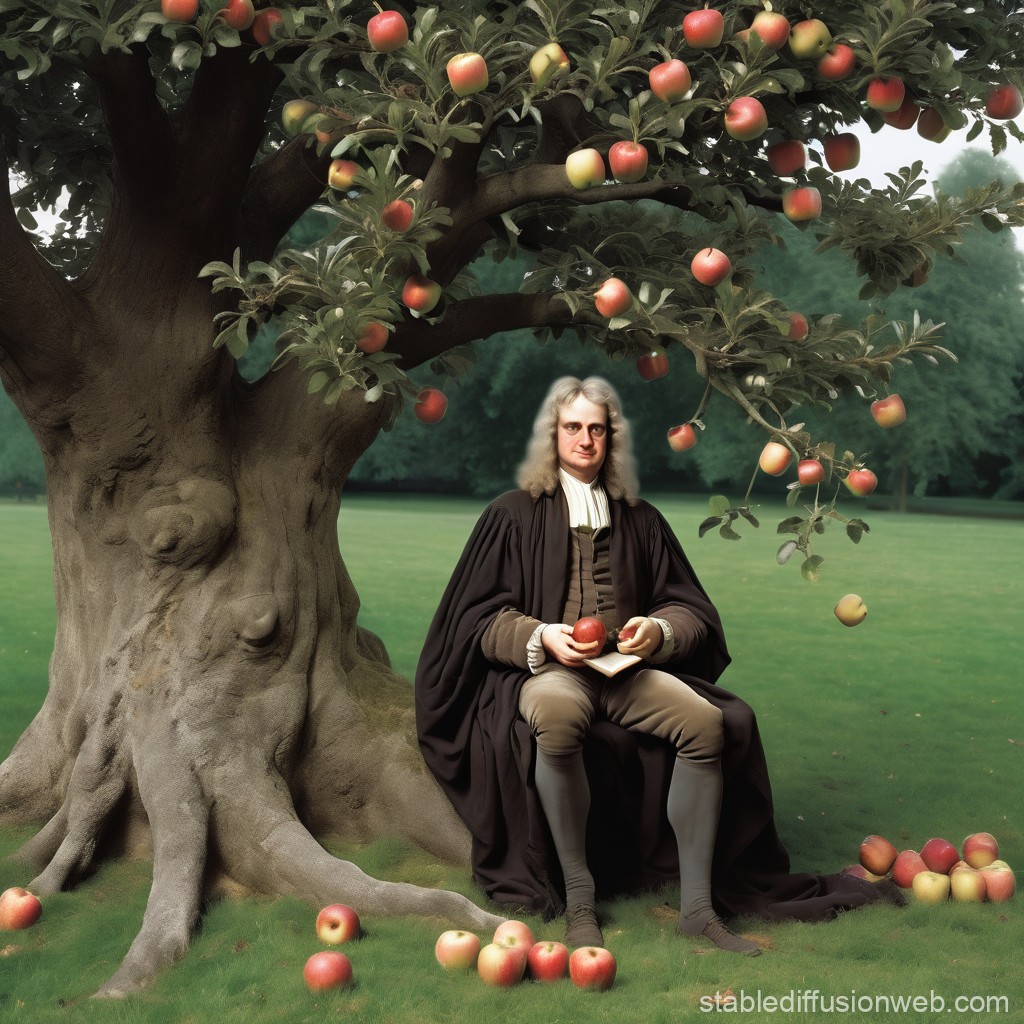
Newton formulated the three famous laws of motion: \[ F = ma, \quad \text{(Second Law)} \] \[ \text{An object in motion stays in motion unless acted upon by a force,} \] \[ \text{For every action, there is an equal and opposite reaction.} \] Together, these created a universal framework for mechanics. His law of gravitation, \[ F = G \frac{m_1 m_2}{r^2}, \] explained both the fall of an apple and the motion of the planets, bridging terrestrial physics with astronomy.
He also developed the generalized binomial theorem for any rational exponent: \[ (1 + x)^n = 1 + nx + \frac{n(n-1)}{2!}x^2 + \frac{n(n-1)(n-2)}{3!}x^3 + \cdots \] which advanced algebraic analysis and infinite series.
Beyond formulas, Newton demonstrated that careful observation, experimentation, and mathematical reasoning could reveal universal principles. His work in optics showed that white light is composed of a spectrum of colors, while his invention of the reflecting telescope improved astronomical observations.
Newton’s methods, combining theory with precise measurement, set the standard for the scientific method and the integration of mathematics with experimental evidence. Centuries later, his influence is seen in engineering, orbital mechanics, and even modern computing algorithms, making his contributions foundational not just in physics, but in all quantitative sciences.
Facts:
- Born in Woolsthorpe, England.
- Invented calculus in the 1660s (independently of Leibniz).
- Expanded and generalized the binomial theorem.
- Built the first practical reflecting telescope.
- Served as Master of the Royal Mint, reforming England’s currency.
- Became President of the Royal Society in 1703.

All rights reserved by the Mathematical Unity
Contact: +8801400044645
Email: mathematicalhorse1453@gmail.com
Our Discord Server: Mathematical Unity [Ulus Riyadiyat]